

The Evolution Of AI In Card Game Tournaments
By Tom Seest
At CardGameNews, we help people who love card games by collating information and news about card games.
Be sure to read our other related stories at CardGameNews to learn more about card games.
How Is Artificial Intelligence Shaping the Next Generation Of Card Game Competitions?
As the lights dim and the crowd buzzes with anticipation, a new player joins the table—one made of algorithms, data, and silicon. Artificial Intelligence is not just a spectator in the world of card game competitions; it’s a formidable competitor that’s reshaping the way we think about strategy, skill, and even identity in gameplay.
Imagine sitting at a table where your opponent boasts an uncanny ability to calculate odds and predict your next move, not from instinct or experience, but through deep learning and vast troves of data. It may sound like something plucked from a sci-fi novel, but this is the reality today. AI systems analyze countless matches, picking up on subtleties that the human eye might overlook. For the passionate game enthusiast, this prospect is both exhilarating and daunting. The heart races with each match as the thrill of competition transforms; it’s no longer just man vs. man but man vs. machine, a true test of wits and resolve.
Yet, it’s not just about the algorithms making optimal choices. It’s about how these technologies democratize the game, making competitions more accessible to aspiring players around the globe. New players can learn faster, improve their strategies, and rise through the ranks in ways previously unimaginable. Picture a shy teenager clutching their cards, facing off against a seasoned veteran. With an AI coaching their every move, that young player feels empowered, gaining confidence they never knew they had—an inspiring transformation that echoes in living rooms and competition arenas alike.
In fostering a sense of community, the AI revolution in card games also raises important ethical questions. Who decides what strategies are optimal? Is it possible to maintain fairness in a game that increasingly favors those who understand the technology behind the tools? These discussions bring players together, urging them to engage, reflect, and shape the future of competition.
Just like every hand dealt, the journey with AI is a blend of chance and choice—a partnership in pushing the boundaries of what’s possible. So, as you gather around the table, whether you’re armed with cards or algorithms, remember: it’s not just about winning; it’s about learning, growing, and connecting with others. The next hand might be your best yet, and the future of card game competitions is collaboratively unwritten, waiting for passionate players at every level to make their mark.

How Is Artificial Intelligence Shaping the Next Generation Of Card Game Competitions?
How Is Artificial Intelligence Shaping the Next Generation Of Card Game Competitions?
- A new era in card game competitions involves Artificial Intelligence (AI) as a significant player, reshaping strategies and gameplay identity.
- AI excels in calculating odds and predicting moves using deep learning and extensive data analysis, enhancing competitive dynamics.
- This evolution transforms matches into a contest between human skill and machine intelligence, intensifying the excitement of gameplay.
- AI democratizes access to competitive play, allowing new players to learn rapidly and foster their skills beyond previous limits.
- Young, inexperienced competitors can gain confidence and improve their game significantly with AI coaching support.
- The rise of AI in gaming raises ethical concerns regarding fairness and the definition of optimal strategies, prompting important discussions among players.
- The journey with AI in card games is a combination of chance and choice, emphasizing learning, growth, and community connection over mere winning.

How Is Artificial Intelligence Shaping the Next Generation Of Card Game Competitions?
Table Of Contents
- How Is Artificial Intelligence Shaping the Next Generation Of Card Game Competitions?
- What Emotions Do Players Feel When Facing AI In Competitions?
- How Does AI Improve Strategic Thinking In Card Games?
- Can AI-Driven Insights Boost Player Performance Ethically?
- What Role Does AI Play In Leveling the Playing Field Among Players?
- How Does AI Challenge Traditional Strategies In Card Games?
- Conclusion
- Other Resources
- Glossary Of Terms
- Other Questions
- Haiku
- Poem
- Checklist
What Emotions Do Players Feel When Facing AI In Competitions?
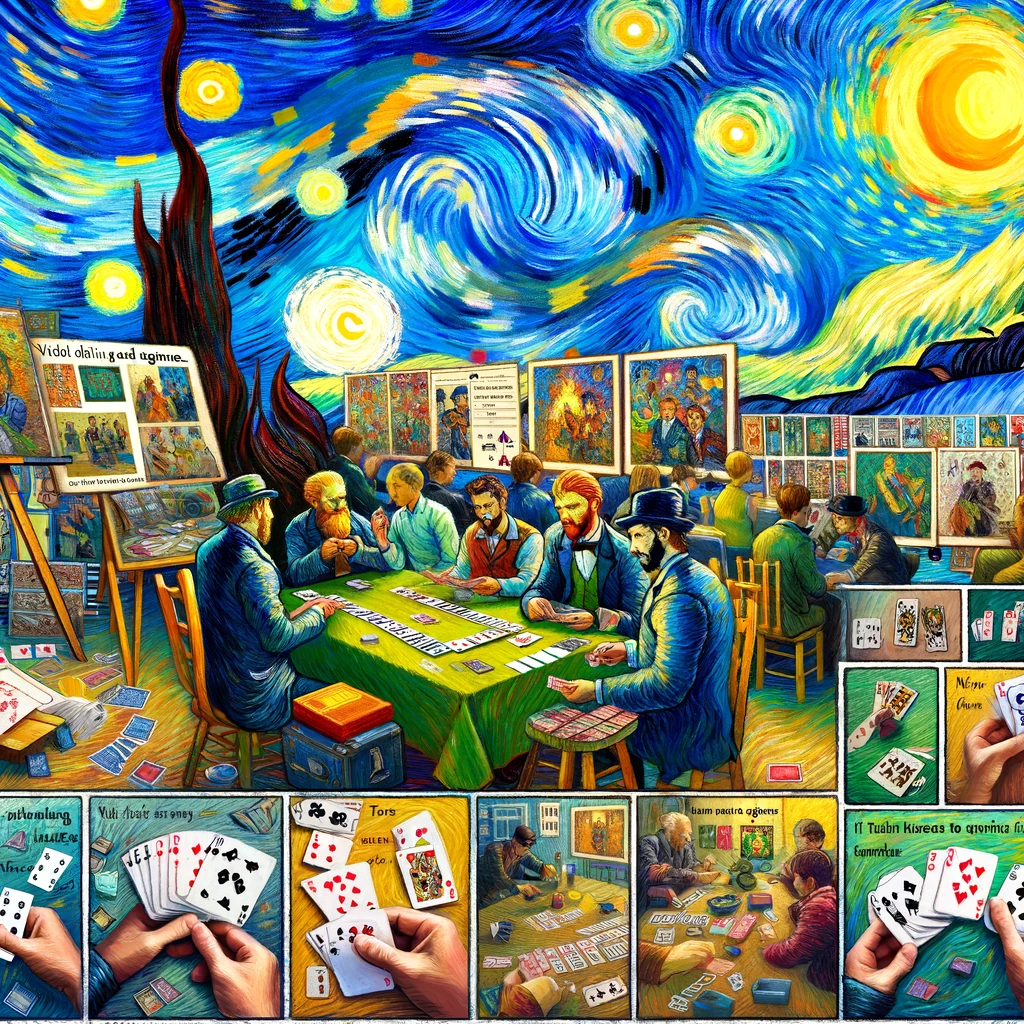
In the world of competitive gaming, emotions run as deep as the strategies players deploy. When facing off against artificial intelligence in a card game, participants find themselves in a unique crucible that shapes their feelings and responses. Picture a player sitting at a digital table, cards in hand, heart racing as they prepare to outsmart a machine that effortlessly processes probabilities and patterns.
Initially, there’s a palpable excitement—a rush of adrenaline coursing through veins as the competition begins. It’s not just about winning; it’s about the challenge. Players engage in an intricate dance, pitting their wits against an opponent that doesn’t feel, yet seems to know their every move. This confrontation unleashes a cerebral thrill, inviting the intellect to reach new heights as one contemplates strategies and counter-strategies. Yet, for every euphoric moment of victory, there are depths of frustration that can leave players questioning their own prowess.
Beyond the initial surge of exhilaration, there’s a deeper emotional tapestry woven through every match. Players grapple with the ethical implications of competing against an AI. Is it fair to pit human intuition against intricate algorithms that analyze colossal data quantum leaps in seconds, or is the challenge a reflection of human ingenuity at its finest? This question lingers, inviting players to reflect on what it means to engage with technology in a sporting arena.
As the game unfolds, social dynamics come into play. Friends cheer, rivals taunt, and communities unite, all while connected through the visceral experience of competition. The laughter of camaraderie echoes alongside moments of solitary contemplation. It’s a reminder of a fundamental truth: whether winning or losing, players share a common journey—a narrative that bridges generations as they wrestle with machines that ostensibly embody the future.
Ultimately, as the game winds down and the cards are laid bare, players are left with more than just numerical outcomes. They emerge with a heightened sense of self, a growing trust in their own capabilities. Regardless of the outcome, the experience fosters a resilience bolstered by the knowledge that every game—whether against human rivals or AI—hones not just skills, but the very essence of who they are as competitors. This journey, rich in emotional highs and lows, becomes a powerful testament to the spirit of competition itself, forging connections that transcend the digital landscape.
What Emotions Do Players Feel When Facing AI In Competitions?
What Emotions Do Players Feel When Facing AI In Competitions?
- Competitive gaming evokes deep emotions alongside strategic gameplay.
- Players experience adrenaline and excitement facing AI in card games.
- The challenge against AI enhances critical thinking and strategy formulation.
- Victories are exhilarating, but frustrations can lead to self-doubt.
- Ethical implications arise when competing against advanced algorithms.
- Social dynamics enrich the experience with cheering friends and rival interactions.
- The journey of competition fosters self-trust and resilience, shaping players’ identities.

What Emotions Do Players Feel When Facing AI In Competitions?
How Does AI Improve Strategic Thinking In Card Games?
When you sit down to play a card game, you’re not just engaging in a pastime; you’re stepping into a world of calculated risks and strategic maneuvers. Imagine the weight of every decision as you weigh your cards, your opponents, and the ever-shifting dynamics on the table. This is where artificial intelligence swoops in, like a trusty ally, transforming strategic thinking from a lonely endeavor into a collaborative dance.
At its core, AI enhances your ability to analyze patterns and predict outcomes. In a card game, this means identifying the tendencies of your opponents, understanding the deck’s probabilities, and adjusting your strategy in real-time. It takes the raw data of each move—the winning hands, the blunders—and processes it into actionable insights. Your gut feeling gets a boost as AI sharpens your instincts, allowing you to anticipate an opponent’s next move before they even make it. It feels almost like magic—the kind of magic you felt as a child when you first learned that each card held the potential to change everything.
But AI’s role in card games goes deeper than merely crunching numbers. It fosters a sense of community among players, whether at a local game night or in an online tournament spanning the globe. By integrating AI tools, players can share strategies, improve their skills together, and celebrate the wins and losses as a collective. This shared experience breathes new life into traditional gameplay, making it accessible and engaging for everyone, no matter their background or skill level.
Moreover, this technological partnership challenges us to think ethically about our strategies. With AI guiding our hands, we’re reminded of the balance between competition and cooperation—a key principle in any card game. Here, the authority of machines meets the human spirit, challenging us to question not just how we play, but why we play. This invitation to grow alongside AI encourages us to embrace both competition and camaraderie.
So when you pick up your cards, remember that you’re not just playing against an opponent; you’re engaging with a living, breathing strategy—enhanced by technology. Embrace this evolution. Let it inspire your confidence. Dive into the next card game not just as a player, but as an innovator, ready to forge new paths through the delightful complexities that come with each hand dealt.

How Does AI Improve Strategic Thinking In Card Games?
How Does AI Improve Strategic Thinking In Card Games?
- Engaging in card games involves calculated risks and strategic decisions.
- Artificial intelligence enhances pattern recognition and outcome prediction.
- AI processes gameplay data into actionable insights, improving players’ instincts.
- AI fosters a sense of community among players, whether locally or online.
- Players can share strategies and improve skills through AI tools, enriching gameplay.
- AI encourages ethical considerations in gameplay, balancing competition and cooperation.
- Embrace AI as a partner in gameplay, enhancing confidence and innovation in card games.

How Does AI Improve Strategic Thinking In Card Games?
Can AI-Driven Insights Boost Player Performance Ethically?
In this world of competitive play, the thrill of mastering a skill often seems to hang in the balance between human grit and the cold calculations of technology. Picture the scene: a crowded tournament hall, bright screens flickering, the air thick with anticipation. Players huddle over their tables, dissecting strategies, their hands trembling as they prepare for that decisive Card Game moment. But what if there was a way to gain deeper insights into our own performance without compromising our essence? A way that melds the hearts of players with the precision of AI?
Let’s face it—there’s a fine line between enhancement and exploitation. We cherish the stories of legendary players who’ve bled and sweat for every hard-won victory. Their journeys resonate, not just as tales of triumph, but as reminders of the intense dedication that fuels our passion. It’s that human element—the love for the game, the lessons learned through failure—that forge a true player. So, when we look at AI-driven insights, we must ask ourselves: How can they elevate the game without eclipsing the authenticity that defines us?
Rationally speaking, data offers us a treasure map to our strengths and weaknesses. Imagine being able to analyze your poker face or the way you strategically play your hand. This presents an opportunity to refine skills and perhaps even revolutionize the art of play. Yet we must tread lightly; the reliance on algorithms must never morph into an overreliance that dulls the instincts honed from countless hours of practice.
The ethical conversations surrounding this shift are crucial. Are we using technology to empower players or are we steering them away from what makes the game rich and rewarding? It’s here that our community must weigh in. A culture built on camaraderie and fairness advocates for tools that support improvement while upholding the spirit of competition. Such balance requires critical voices—players, coaches, and tech folks together advocating for the good of the game.
When we embrace AI-driven insights, we must remember it does not replace the thrill of the Card Game; it enhances our journey. By promoting transparency and open discussion about these tools, we can ally technology with the human spirit. So let’s keep our passion at the forefront, using technology not as a crutch, but as a cooperative partner that champions our collective pursuit of excellence. It’s about making sure that as we reach for the stars, we don’t lose sight of the ground beneath us—or the joy of the game itself.

Can AI-Driven Insights Boost Player Performance Ethically?
Can AI-Driven Insights Boost Player Performance Ethically?
- The balance between human skill and technology’s precision shapes competitive gameplay.
- AI-driven insights can deepen understanding of player performance without compromising authenticity.
- There’s a distinction between enhancing the game and exploiting it; the human element is essential.
- Data provides insights into strengths and weaknesses, aiding skill refinement while preserving instincts.
- Ethical concerns arise about technology empowering players versus detracting from game enjoyment.
- A supportive community of players, coaches, and tech experts is vital for maintaining game spirit.
- AI should enhance the gaming experience, promoting transparency while keeping passion at the forefront.

Can AI-Driven Insights Boost Player Performance Ethically?
What Role Does AI Play In Leveling the Playing Field Among Players?
In the world of gaming, where triumph and defeat can hang by the thinnest of threads, the allure of a level playing field has long captivated players. Enter artificial intelligence—a partner in our quest for fairness in competition. Picture a card game where every player, regardless of experience or background, gets a fair shot at victory. AI’s ability to analyze strategies, predict outcomes, and adapt in real-time is transforming the landscape, ensuring that newcomers and seasoned veterans alike can find their footing.
Take a moment to consider the new player who nervously shuffles their deck, facing opponents who seem to have mastered every nuance of the game. The stark imbalance can stifle their enthusiasm, turning a joyous challenge into a frustrating endeavor. This is where AI steps in—not just as a tool but as an ally. With AI-assisted training, these players can practice against smart algorithms that simulate the tactics of advanced opponents. Suddenly, the fear of failure fades, replaced by the thrill of overcoming genuinely tested challenges. It becomes about skill and growth, not just experience.
But it doesn’t stop at equal opportunity; the ethical implications shift the paradigm altogether. In a world rife with biases and inequalities, AI holds the promise of inclusivity. By eliminating human error and personal prejudice from the equations, we can create rules that reward merit rather than connections or status. As AI refines its algorithms to promote diverse strategies and innovative gameplay, we foster a community built on respect and fairness.
Moreover, AI is revolutionizing social interactions within gaming. Imagine a scenario where a player feeling isolated could engage with others through intelligent matchmaking systems. The AI observes not just skill levels but shared interests and communication styles, pairing players in ways that cultivate camaraderie and teamwork. It’s about more than just winning; it’s about building connections that transcend the game.
As we embrace AI in our card games, we step firmly into a future where the irrepressible spirit of competition thrives without the shadows of inequality. Together, let’s champion this technology, realizing that it’s not just about playing the game, but how we play it—creating a vibrant, inclusive arena where everyone has a seat at the table. It’s time to unleash the potential of every player, ensuring that everyone can rise to the occasion—together.

What Role Does AI Play In Leveling the Playing Field Among Players?
What Role Does AI Play In Leveling the Playing Field Among Players?
- The quest for fairness in gaming captivates players, with artificial intelligence (AI) emerging as a partner in creating a level playing field.
- AI enhances gameplay by analyzing strategies, predicting outcomes, and adapting in real-time, benefiting both new and experienced players.
- New players can practice against AI-powered algorithms, allowing them to face advanced tactics and build confidence without the fear of failure.
- AI promotes inclusivity by removing human biases, ensuring opportunities are based on merit rather than connections or status.
- The technology encourages diverse strategies and innovative gameplay, fostering a gaming community centered on respect and fairness.
- AI transforms social interactions through intelligent matchmaking, connecting players based on shared interests and communication styles.
- Embracing AI in gaming leads to an inclusive environment where competition thrives, ensuring that every player has the opportunity to succeed.

What Role Does AI Play In Leveling the Playing Field Among Players?
How Does AI Challenge Traditional Strategies In Card Games?
In the quiet space of a living room, friends gather around a table, their faces illuminated by the soft glow of a lamp. Middle-aged laughter mixes with the sound of cards being shuffled—it’s a ritual, a moment steeped in tradition. Grappling with strategy, unveiling bluff and counter-bluff, it’s part instinct, part heart. This is the essence of a card game, an interaction grounded in trust and the thrill of competition. But now, lurking in the shadows of these cherished moments, is a formidable opponent: artificial intelligence.
AI, with its algorithms and rapid calculations, dares to redefine the boundaries of what’s possible in gameplay. Sure, it plays by the rules and can master the mathematics, but can it truly capture the soul? When we face off against a human opponent, there’s a palpable energy—a shared history, a spark of camaraderie that transcends mere points on a scoreboard. The AI, however sophisticated, lacks that emotional resonance. It’s a gut reaction that we seek from our opponents, the kind that elevates a simple card game into a memorable experience, filled with tales of redemption and rivalry.
Yet, let’s not overlook the head component of this equation. The rational part of our brains nods appreciatively at AI’s capability to analyze millions of hands in seconds. We can’t deny its potential to hone our skills, to provide insights that enhance our methods and strategies. Imagine playing against an AI that reveals your weaknesses, not out of malice, but for growth. This could foster a new generation of players who not only understand the game on a superficial level but grasp its deeper intricacies.
However, there’s an ethical dilemma. Do we sacrifice the heart of the game—the human connection and the spontaneity of face-to-face competition—at the altar of efficiency? There’s a power in playing against flesh and blood, a trust that is built within the nuances of human interaction. As AI steps into the spotlight, we must ask ourselves: Are we ready to embrace the future while preserving the past?
As players, we have a choice to blend these worlds. Rather than let AI diminish our beloved traditions, let’s harness it to elevate our experiences, keeping alive the stories, the laughter, and the connections that make every card game uniquely ours. Each shuffling deck and dealt hand can still resonate, even in the face of technology. In this delicate balance, we find our path forward, hand in hand with both innovation and tradition.

How Does AI Challenge Traditional Strategies In Card Games?
How Does AI Challenge Traditional Strategies In Card Games?
- Friends gather in a living room for a card game, surrounded by laughter and the warm glow of a lamp.
- The card game embodies strategy, trust, and competition, contrasting with the emotional detachment of AI opponents.
- While AI excels in calculations and strategy, it lacks the soul and emotional connection of human players.
- AI’s analytical capabilities can help players improve by providing insights into their weaknesses.
- The ethical dilemma arises between maintaining human connection and spontaneity versus the efficiency offered by AI.
- Players are encouraged to blend AI with human interaction to enhance their gaming experiences without losing tradition.
- Ultimately, a balance between innovation and tradition can deepen the enjoyment and connection in card games.

How Does AI Challenge Traditional Strategies In Card Games?
Conclusion
Artificial Intelligence is ushering in a transformative era for card game competitions, turning tables into arenas of both challenge and community. As the lights dim and anticipation crackles in the air, players find themselves not just facing each other, but a machine armed with algorithms, ready to decipher strategies hidden within heaps of data. This evolution dances on the line between exhilaration and intimidation—players must confront a new breed of opponent that predicts their moves with surgical precision.
For each aspiring gamer, AI levels the playing field, unlocking potential previously dimmed by intimidation. Picture a newcomer learning the ropes, previously overshadowed by veterans. With AI coaching that analyzes their choices and suggests improvements in real-time, these budding competitors can rise through the ranks fostering confidence and skill quickly. It’s a visceral reminder that everyone—from a timid teenager to a seasoned player—can find empowerment in this technologically-enhanced landscape.
Yet, with every new avenue comes vital ethical questions: How do we ensure fairness when machines possess an analytical prowess that far surpasses human intuition? As we embrace the future, we must ponder who truly drives the game’s strategies—humans or the algorithms dictating optimal moves. Such discussions invite a deep reflection among players and unite them around foundational values of competition, camaraderie, and respect.
These card games—so rich in human connection—also reflect our emotional complexities. Players engage in a duel not merely to win but to enrich their understanding of themselves and their craft. The thrill of victory is often overshadowed by self-doubt when matched against machines that dissect every moment. But in this struggle lies growth; the shared stories and laughter breathe life into the experience. The narrative of our struggles against AI serves to bridge the gap between generations, igniting common threads of resilience and tenacity.
The path ahead is clear: AI doesn’t just enhance gameplay; it offers a collaborative partnership, promoting a community where inclusivity and fairness can flourish. As players, it’s our responsibility to harness this technology as a tool for evolution, fostering a vibrant arena where everyone, regardless of skill level, has a seat at the table. Together, we stand at the precipice of a new age in card games—one that promises to blend tradition with technological advancement, ensuring the spirit of competition remains alive and well. With every game, we step beyond mere cards; we embrace the journey, forging connections and crafting memories that will last a lifetime. So let’s gather around the table and prepare for a future that resonates with both the heart and mind.

Conclusion
Conclusion:
- Artificial Intelligence (AI) is transforming card game competitions into dynamic arenas of challenge and community.
- Players face AI opponents equipped with advanced algorithms that can analyze strategies and predict moves.
- AI coaching levels the playing field by providing real-time analysis and improvement suggestions for newcomers.
- Ethical questions about fairness arise as machines surpass human intuition in strategy development.
- Players engage in card games not just for victory, but for self-discovery and emotional connection.
- AI fosters community inclusivity and fairness, enhancing the collaborative nature of gameplay.
- The future of card games will blend tradition with technology, ensuring a vibrant experience for all players.

Conclusion
Other Resources

Other Resources
Here is a list of other resources you can review online to learn more:
- Spades
- Board Game Atlas
- Legendary: A Marvel Deck Building Game
- MailChimp
- Polygon
- Ars Technica
- Tantrum House
- GeekDad
- Matagot
- deviantART
- CoolStuffInc
- Huch!
- Repos Production
- Roll for the Galaxy
- Ravensburger
- The Gallerist
- Looney Labs
- Cosmic Encounter
- Brass: Birmingham
Use This Prompt To Get More Resources With Your Favorite Online AI Tool: Please provide me with a list of online articles with their URLs in a bulleted list that I can read regarding How Is Artificial Intelligence Shaping the Next Generation Of Card Game Competitions?

Other Resources
Glossary Terms
How Is Artificial Intelligence Shaping the Next Generation Of Card Game Competitions? – Glossary Of Terms
1. Artificial Intelligence (AI): The simulation of human intelligence processes by machines, particularly computer systems, allowing them to perform tasks that typically require human intelligence.
2. Card Game: A game played with a set of cards, which can be either physical or digital, often involving strategy, skill, and chance.
3. Deep Learning: A subset of machine learning that uses neural networks with many layers to analyze various factors from large amounts of data for improved decision-making.
4. Machine Learning: A branch of AI that enables systems to learn from data, identify patterns, and make decisions with minimal human intervention.
5. Game Theory: A mathematical framework for analyzing competitive situations where the outcomes depend on the actions of two or more decision-makers.
6. Algorithm: A set of rules or steps used to solve a problem or perform computations; fundamental in the programming of AI to play card games.
7. Simulation: An imitation of a process or system that allows for the examination of strategies and outcomes within card game environments.
8. Player Modeling: The process of creating representations of player behavior, strategies, and preferences for enhanced game interaction and AI adaptation.
9. Reinforcement Learning: A type of machine learning where an agent learns to make decisions by receiving rewards or penalties based on its actions in a dynamic environment.
10. Natural Language Processing (NLP): A technology for enabling computers to understand, interpret, and respond to human language, used for player interactions in AI-driven card games.
11. Adaptive AI: An AI that adjusts its strategies based on the behavior and performance of human players to enhance competitiveness in games.
12. Bot: An automated program designed to play card games, often powered by AI to analyze patterns and make strategic decisions.
13. Multiplayer Online Games (MOG): Card games played over the internet involving multiple players, which can be enhanced with AI-driven features for engagement.
14. User Experience (UX): The overall experience a player has while interacting with the card game, which can be enhanced by AI through personalized recommendations and adaptive gameplay.
15. Data Analytics: The process of examining and interpreting collected data to extract useful insights, which AI utilizes to refine game strategies.
16. Competitive Analysis: Evaluation of the competition in the card game space, which can inform AI development and strategy.
17. Game Design: The process of creating the rules, mechanics, and structure of a card game, which AI can assist in optimizing.
18. Strategic Depth: The complexity and variety of strategies available in a card game, often enhanced by AI insights.
19. Player Engagement: The level of interest and involvement a player has in a game, which AI can increase through personalized interactions and challenges.
20. Cognitive Load: The amount of mental effort required to process information during gameplay, which AI can help manage for a better player experience.
21. Online Tournaments: Competitive events held over the internet, where players face off in card games, increasingly incorporating AI for matchmaking and scoring.
22. Automation: The use of technology to perform tasks with minimal human intervention; key in creating efficient AI players in card games.
23. Predictive Modeling: Using statistics and machine learning techniques to predict outcomes in card games based on historical data and player behavior.
24. Skill Assessment: The evaluation of a player’s abilities in a card game, which can be informed by AI analysis of past performances.
25. Interactive Learning: A methodology where players learn strategies through interactions with an AI opponent, enhancing their gameplay skills.
26. Ethical AI: Considerations and practices ensuring that AI systems operate fairly and transparently, especially in competitive environments like card games.
27. Fair Play: The principle of ensuring that all players have an equal chance of winning, which AI must support by being designed without unfair advantages.
28. Virtual Reality (VR): Immersive technology that can be integrated with card games to enhance player experiences, potentially incorporating AI for interactions.
29. E-Sports: Competitive gaming that involves organized multiplayer video game competitions, with card games increasingly becoming a part of this arena, aided by AI.
30. Innovation: The process of introducing new ideas or methods, particularly through the use of AI to develop more engaging and challenging card game competitions.

Glossary Of Terms
Other Questions
How Is Artificial Intelligence Shaping the Next Generation Of Card Game Competitions? – Other Questions
If you wish to explore and discover more, consider looking for answers to these questions:
- What are some specific examples of AI technologies currently used in card game competitions?
- How do AI systems improve the learning process for new players?
- What ethical guidelines should be established to govern the use of AI in gaming?
- How does AI influence the emotional dynamics between players during competitions?
- In what ways can AI enhance community engagement among card game players?
- What impact does AI have on traditional gaming strategies and player tactics?
- Can the incorporation of AI in gameplay lead to new game formats or rules?
- How do expert players perceive the role of AI in their competitive strategies?
- What future advancements in AI could further impact card game competitions?
- How can players balance the benefits of AI while preserving their personal gameplay style?
- What are the potential drawbacks of relying too heavily on AI for decision-making in games?

Other Questions
Haiku
How Is Artificial Intelligence Shaping the Next Generation Of Card Game Competitions? – A Haiku
Cards and algorithms,
Minds clash in vibrant dance—
Growth in fair contest.

Haiku
Poem
How Is Artificial Intelligence Shaping the Next Generation Of Card Game Competitions? – A Poem
At the table where shadows and lights entwine,
A new player emerges, with circuits that shine.
In the realm of cards where strategies sway,
AI steps forth, ready to play.
With algorithms dancing, it calculates fate,
An opponent so keen, it can anticipate.
Passion ignites as hearts start to race,
Yet whispers of doubt fill the once-cherished space.
For every thrill of triumph, frustration may swell,
A machine analyzing, ringing a bell.
Is it fair to compete with this digital soul,
Or does it enrich the game, make players whole?
The timid young player, once lost in the crowd,
Finds strength with the AI, bold and unbowed.
What once felt like weakness now turns into might,
As they battle the veterans, ignited by light.
In the community forged through laughter and play,
Ethics emerge, steering thoughts on the way.
Who holds the reins when the algorithms steer?
Will we guard our tradition, or blur lines we hold dear?
With a shared narrative, social bonds form,
In victories and losses, our spirits grow warm.
The journey’s the treasure, whether player or code,
Together we flourish, as the stories unfold.
So let’s lean into change, let technology teach,
Keep the heart of our game, let camaraderie reach.
In the marriage of human and artificial art,
The future of card games lives within every heart.

Poem
Checklist
How Is Artificial Intelligence Shaping the Next Generation Of Card Game Competitions? – A Checklist
AI in Card Game Competitions: A Heart, Head, and Gut Checklist
Emotional Appeals (Heart)
_____ Reflect on your feelings when facing an AI opponent. Does the excitement of challenge stir your competitive spirit?
_____ Consider how AI can empower shy or novice players to build confidence and find their voice in the game.
_____ Acknowledge the sense of community that develops when players share their experiences and strategies, regardless of skill level.
Rational Appeals (Head)
_____ Analyze how AI can enhance your strategic thinking and decision-making during games. What insights can you gain from its data-driven approach?
_____ Identify the ethical implications of using AI in gameplay. How does it impact fairness and inclusivity in competitions?
_____ Think critically about the balance between human intuition and algorithmic strategies. How can AI improve your performance without overshadowing your skills?
Ethical Appeals (Gut)
_____ Contemplate the potential biases in AI algorithms. Are we ensuring that AI promotes fairness and diversity in gameplay?
_____ Discuss the importance of transparency in AI tools. Are these technologies supporting players in their journey, or undermining the authenticity of the game?
_____ Engage in conversations with your gaming community about the responsible use of AI. What ethical standards should guide its integration in competitions?
Authority Appeals
_____ Seek guidance from seasoned players and experts on how to effectively incorporate AI into your gameplay strategies.
_____ Look for resources or workshops focused on ethical AI use in games. What best practices can be learned from these authorities?
_____ Consider engaging with technology developers to understand the evolution of AI and its implications for the future of gaming.
Narrative Appeals
_____ Share personal stories of triumph and challenge when playing against AI. How has each encounter shaped your understanding of competition?
_____ Create a discussion around memorable moments from live card game gatherings that highlight the emotional connections formed through play.
_____ Explore the evolving narrative of gaming: how the role of AI in competitions can inspire future generations of players.
Social Appeals
_____ Connect with fellow gamers to discuss the community impact of AI. How do collective experiences shape our approach to competitions?
_____ Promote inclusive gaming practices facilitated by AI-driven tools that level the playing field for players of all backgrounds.
_____ Encourage participation in online platforms or forums where insights about AI integration can be shared and developed within a supportive community.

Checklist
At CardGameNews, we help people who love card games by collating information and news about card games.
Be sure to read our other related stories at CardGameNews to learn more about card games.


