Crafting Interactive Narratives With Ai In Card Games
By Tom Seest
At CardGameNews, we help people who love card games by collating information and news about card games.
Be sure to read our other related stories at CardGameNews to learn more about card games.
Can Artificial Intelligence Embrace The Art Of Storytelling In Card Game Journeys?
In an era defined by rapid technological progress, the intersection of artificial intelligence and storytelling in card game journeys has become a fascinating battleground. Picture yourself sitting at the table, cards in hand, with your friends or family, eyes gleaming with anticipation. The laughter, the tension, the thrill of competition—these moments form not just a game but cherished memories. Now, imagine that each card you play contains a deeper story, woven by the hand of artificial intelligence, capable of evolving with every shuffle.
Let’s be clear: AI isn’t here to replace the human touch. It’s about enhancing our experiences, forging connections in ways we’ve yet to explore. There’s something profoundly comforting about the age-old art of storytelling, the way it draws us in and kindles our imagination. Picture a future where a card game doesn’t just present challenges but also narrates the vibrant world behind each card. Imagine a dragon battling a knight not just as pieces on a board, but as part of a saga that resonates with your own life story.
Rationally, consider the potential for personalized narratives. AI can analyze the choices and strategies of players, crafting tailored arcs that reflect their gaming style and preferences. This ability enriches the card game experience, encouraging repeat play and deeper engagement. Why settle for a static tale when you can co-author an adventure that feels uniquely yours?
Ethically, we must navigate this terrain with care. Storytelling in games carries a responsibility. It’s about shared values, building empathy, and expanding our horizons. Let’s ensure that the narratives we cultivate promote positivity and inclusivity. The cards we play should encourage a sense of community, not division.
In creating these experiences, we tap into the innate power of storytelling—an ancient craft that has unified people across cultures and generations. The journey through a card game need not be just a competition; it can transform into a shared odyssey that thrives on the connections we build, both with each other and the stories unfolding around us.
So, as we stand at this crossroads of innovation and tradition, let’s embrace the possibilities. The art of storytelling isn’t fading; it’s adapting, growing. It invites us all into the narrative, allowing us to play our parts, one card at a time.

Can Artificial Intelligence Embrace The Art Of Storytelling In Card Game Journeys?
Can Artificial Intelligence Embrace The Art Of Storytelling In Card Game Journeys?
- The intersection of AI and storytelling in card games creates engaging, memorable experiences.
- AI enhances our experiences rather than replacing the human touch, fostering deeper connections.
- Card games can narrate vibrant stories, adding layers beyond mere gameplay.
- AI can craft personalized narratives based on player choices, enriching engagement.
- Storytelling in games carries ethical responsibilities to promote positivity and inclusivity.
- Creating shared experiences through storytelling can strengthen community bonds.
- Embracing innovation in storytelling allows us to play unique parts in ever-evolving narratives.

Can Artificial Intelligence Embrace The Art Of Storytelling In Card Game Journeys?
Table Of Contents
- Can Artificial Intelligence Embrace The Art Of Storytelling In Card Game Journeys?
- Is Ai Capable Of Creating Emotionally Resonant Stories?
- How Do We Define A Good Story In Ai-Generated Content?
- Can Ai Improve Storytelling By Learning From Human Experiences?
- Should We Trust Ai To Convey Complex Narratives In Card Games?
- How Does Storytelling In Games Impact Our Emotional Connection?
- Conclusion
- Other Resources
- Glossary Of Terms
- Other Questions
- Haiku
- Poem
- Checklist
Is Ai Capable Of Creating Emotionally Resonant Stories?
When you sit down to play a card game, each shuffle, deal, and discarded hand represents a fusion of chance and choice, a miniature reflection of life itself. In the world of storytelling—whether it’s through literature, film, or even the droplet of a digital narrative—you find a similar dance of chaos and intent. Now, as artificial intelligence ventures into this sacred space, we’re left grappling with an essential question: can it truly create emotionally resonant stories?
On one hand, the logic is undeniable. AI algorithms can analyze hundreds of thousands of narratives, identifying patterns that resonate with audiences. They can mimic the nuanced beats of a classic tale, pulling in the tropes that tug at our hearts or tickle our funny bones. But there’s a fine line between imitation and creation. When we peel back the layers of a powerful story—those moments that bring tears or laughter—we find the fingerprints of human experience. There’s vulnerability in shared pain, triumphs that echo our personal struggles, and dreams that mirror our aspirations.
Think about the last great story you experienced. What made it resonate? Was it the camaraderie of the characters, the stomach-churning tension that kept you on edge, or the relatable flaws that reminded you of your own? These elements come not just from data points but from a deep understanding of the human condition. When a storyteller draws upon joy, heartbreak, or the quiet, fierce love between friends, that’s a soul stirring in its own right—something far more intricate than algorithms can predict.
Now consider ethics in this brave new world of AI creativity. It’s one thing to recognize patterns; it’s another to understand the repercussions of telling a story. Who benefits from the tale? Whose voices might be silenced? As we hand the pen to machines, it becomes our responsibility to ensure narratives are not just profitable but also respectful and representative of the kaleidoscope of human experience.
Therein lies our own role in this evolving landscape. By holding creators—human and AI alike—accountable, we foster an environment where authentic, resonant stories can thrive. It’s a collective card game, where each player brings their own stack of experiences to the table, challenging AI to do more than mimic: to listen, learn, and ultimately connect with the humanity that binds us all. We must ask ourselves: will we settle for algorithms, or will we insist on the real thing?

Is Ai Capable Of Creating Emotionally Resonant Stories?
Is Ai Capable Of Creating Emotionally Resonant Stories?
- Playing a card game illustrates the blend of chance and choice, similar to storytelling.
- AI is entering storytelling, raising the question of whether it can create emotionally resonant narratives.
- AI can analyze existing narratives and replicate successful patterns but struggles with true creation.
- Powerful stories are rooted in human experience, reflecting shared emotions like joy and pain.
- Lasting stories resonate due to deep, authentic connections, not just data-driven structures.
- Ethical considerations arise in AI storytelling, questioning whose stories are told and who may be marginalized.
- Both human and AI creators must be held accountable to ensure diverse and meaningful narratives emerge.

Is Ai Capable Of Creating Emotionally Resonant Stories?
How Do We Define A Good Story In Ai-Generated Content?
In the realm of AI-generated content, discerning what constitutes a “good story” is akin to playing a complex card game. Each element—characters, plot, conflict, and resolution—represents a unique card in your hand, and how they are played can determine the game’s outcome. Just as in life, where our experiences shape our understanding of what’s meaningful, a compelling story is a carefully balanced act of emotional resonance and intellectual engagement.
At its core, a good story needs an emotional heartbeat. Think about the tales that have gripped you throughout your life. Were they the ones that simply stated facts, or were they the ones that tugged at your heartstrings? In AI-generated content, the narrative must not only inform but also evoke feelings. The bond formed with characters allows us to walk alongside them, experiencing their triumphs and tribulations as if they were our own. It’s about creating a shared journey, where your audience feels seen and heard, reminding them of their own struggles and victories.
But let’s not overlook the rational aspect. A story needs logic, coherence, and a purpose. It’s essential for the narrative to unfold in a way that not only captivates but also encourages critical thinking. This is where the tradition of storytelling evolves. We’re no longer satisfied with mere entertainment; we yearn for depth. Good stories educate and inspire while holding a mirror up to society, urging us to confront our beliefs and values. An AI capable of generating this depth paves the way for an empowered audience, fostering resilience and curiosity.
Ethically speaking, the stories we choose to tell—and how we tell them—carry immense weight. Our collective narrative crafts our social fabric, so we must wield the power of storytelling with responsibility. When AI contributes to this narrative, it should do so with integrity. The stories should reflect diverse voices and experiences, inviting everyone to the table and ensuring no one is left out of the conversation.
Ultimately, engaging with AI-generated stories is an invitation to explore new worlds, confront our perceptions, and connect with one another. Like a well-played hand in a card game, the right blend of emotion, reason, and ethical storytelling can turn a simple narrative into something truly transformative. So, what’s the next story you’ll choose to tell, and how will you play your cards?

How Do We Define A Good Story In Ai-Generated Content?
How Do We Define A Good Story In Ai-Generated Content?
- Discerning a “good story” in AI-generated content resembles a complex card game, where elements like characters, plot, conflict, and resolution are key components.
- A compelling story requires an emotional heartbeat, evoking feelings and creating a bond between the audience and characters.
- Good stories are not just informative but also resonate emotionally, allowing audiences to relate to characters’ triumphs and tribulations.
- Logic, coherence, and purpose are essential for narratives to captivate while encouraging critical thinking and depth.
- Stories should educate, inspire, and reflect societal values, urging audiences to confront their beliefs.
- Ethical storytelling is crucial; narratives must reflect diverse voices and experiences, promoting inclusivity and responsibility.
- Engaging with AI-generated stories invites exploration, self-reflection, and connection, transforming simple narratives into meaningful experiences.

How Do We Define A Good Story In Ai-Generated Content?
Can Ai Improve Storytelling By Learning From Human Experiences?
In a world woven together by tales of human experience, the question looms large: can artificial intelligence improve storytelling by capturing the nuances of our stories? Picture this: a vibrant circle of friends gathered around a table, sharing laughter and heartbreak, hopes and fears—the raw elements of our shared humanity. Here, amidst the banter and the card game they’re playing, there’s an organic flow of ideas that AI—no matter how advanced—still struggles to replicate. Yet, what if we could invite AI to join that circle, learning from the emotional currents of our stories in real time?
The head wants to know the mechanics, the algorithms that could dissect our narratives, understanding not just the structure of a good tale but the soul behind it. Wouldn’t it be fascinating if AI could analyze the laughter around the table, the pauses as someone grapples with words, the sighs that hint at unspoken truths? These are signals, rich with context and meaning, that could allow AI to cultivate a library not merely of stories, but of understandings that resonate deeply with us.
But let’s turn to the heart for a moment. Our narratives are more than plots; they are the vessels of our experiences—our joys, our struggles, our failures, and triumphs. When AI taps into these depths, it could become a vital partner in our creative endeavors, an ally that enhances our narratives rather than diminishing them. The synthesis of human empathy and machine learning could bridge generations, making stories accessible to all and ensuring that voices once silenced reverberate loudly.
Now, ethically, we must consider the implications. We share our stories with a trusted circle—not a cold machine. Building a framework that preserves the sanctity of storytelling while allowing AI to contribute is crucial. People want to feel that their stories are honored, not commodified. It’s about relationship, trust, and a mutual understanding that extends beyond simple code.
Storytelling is a shared human experience. If we approach this collaboration with intent and care, we could create a new realm where the lines between human experiences and AI-generated tales blur just enough to foster deeper connections, urging us toward a vibrant and inclusive tapestry of narratives. So, the real adventure? Let’s shuffle the deck and see where this partnership takes us. After all, storytelling is a card game with endless possibilities. Together, we can explore them all.

Can Ai Improve Storytelling By Learning From Human Experiences?
Can Ai Improve Storytelling By Learning From Human Experiences?
- AI has the potential to enhance storytelling by understanding human emotions and experiences.
- A vibrant interpersonal setting can generate ideas that AI struggles to replicate.
- AI could analyze emotional signals, such as laughter and pauses, to develop richer narratives.
- By tapping into raw human experiences, AI can become a valuable partner in creativity.
- Ethical considerations are essential, as storytelling involves trust and honoring personal narratives.
- A collaboration between human empathy and AI could create a tapestry of inclusive stories.
- The exploration of AI in storytelling opens up endless creative possibilities.

Can Ai Improve Storytelling By Learning From Human Experiences?
Should We Trust Ai To Convey Complex Narratives In Card Games?
As we dive into the world of card games, where every shuffle can change the fate of a player’s journey, we find ourselves at an intriguing crossroads: Should we put our trust in AI to navigate these complex narratives? Imagine, for a moment, the nights spent around a worn table, laughter echoing as players weave their stories, each card a brushstroke in a larger masterpiece. These moments are what make our connections profound. But can a machine grasp the emotional weight we invest in these interactions?
On the surface, trusting AI in card games might feel like letting a calculator run the numbers for a heartfelt decision. Most of us are driven by emotions—stories told through victories, losses, betrayals, and alliances forged. Yet, AI offers a different kind of logic, analyzing gameplay patterns with precision that human minds sometimes miss. It can identify the intricacies of a narrative in ways that engage our rational side. Imagine algorithms understanding not just the rules, but the implications of each play—revealing strategies hidden beneath our instincts.
Now, let’s consider the ethical dimensions. Does handing over this responsibility to AI compromise the essence of the game? If we embrace its capabilities, what might we lose? Yet, in the hands of skilled developers who understand narrative and game dynamics, AI can enrich experiences without overshadowing the human spirit. AI could serve as a mentor, offering insights that could translate a good game into a great one.
As social creatures, we gravitate toward connection. We want to feel the pulse of the game, the thrill of unpredictable outcomes. AI can help orchestrate these experiences, guiding players through rich storytelling, much like a well-respected game master would. With authority grounded in data, AI can elevate the narratives we create, ensuring every card played contributes meaningfully to the tale.
The heart says: Yes, let’s embrace this innovation. The head nods approvingly, recognizing the potential for deeper gameplay. The gut, ever cautious, urges us to tread incrementally, ensuring we remain the authors of our own stories. In this era of technological marvels, let’s not shy away from the journey ahead. Trust AI, but keep your human touch close, allowing the magic of storytelling in card games to flourish, one card at a time.

Should We Trust Ai To Convey Complex Narratives In Card Games?
Should We Trust Ai To Convey Complex Narratives In Card Games?
- Card games involve intricate narratives shaped by player interactions and emotions.
- Trusting AI in card games raises questions about the emotional depth and human connection involved.
- AI can analyze gameplay patterns more effectively than humans, revealing strategies and insights.
- Embracing AI may alter the essence of traditional gameplay, prompting ethical considerations.
- With skilled developers, AI can enhance storytelling without overshadowing human experiences.
- AI can facilitate richer narratives and unpredictable outcomes, akin to a game master.
- Balancing innovation with human touch is crucial to preserving the magic of storytelling in card games.

Should We Trust Ai To Convey Complex Narratives In Card Games?
How Does Storytelling In Games Impact Our Emotional Connection?
Let’s take a moment to consider the nature of a card game. At first glance, it seems like a simple pastime—a few colorful pieces of cardboard, shuffled and dealt. But intertwined within each play lies a tapestry of stories waiting to unfold. The cards themselves become conduits for connection—not just between players and the game, but among players themselves. This interaction taps into something deep, something human.
When we sit down for a game, especially one filled with rich storytelling, we don’t just engage our hands; we engage our hearts and minds. Think back to those moments when a well-timed decision changes the course of a match. It’s thrilling! The emotional stakes rise, our hearts race, and suddenly, we’re not just playing a game—we’re immersed in a narrative that demands our attention and elicits powerful feelings. We celebrate victories together and soothe the sting of losses communal rain, reinforcing our social bonds in the process.
But beyond that raw emotional rush, there’s a deeper, rational aspect beneath the surface. Good storytelling in games leads us to think critically—about choices, consequences, and the path not taken. Just like in life, every decision matters. In a card game, the weight of our moves becomes a striking reminder that life, too, is a series of calculated decisions. It sparks introspection, prompting us to ask ourselves, “What would I do in this situation?” When narratives resonate with us, they empower us, turning mere entertainment into profound lessons about our values, our ethics, and our own identities.
Moreover, there’s authority in a well-crafted story. When developers and writers weave intricate tale lines into gameplay, they invite us to trust in their vision. These creators become guardians of our emotional experiences, guiding us through highs and lows with expertise. That’s why we don’t just ‘play’ a game—we live it, breathing life into characters and exploring their worlds as if they were our own.
These narratives foster community—where shared stories become the glue binding us together. As we recount our triumphs, laugh at our blunders, or share strategic insights, we forge connections that matter. In this way, storytelling in games is more than just a mechanic; it’s a pathway to understanding ourselves and each other. So, the next time you shuffle your deck or draw a card, remember: you hold more than just rules and strategy. You hold the potential for connection, growth, and the beautiful complexity of the human experience right in your hands. Isn’t that worth celebrating?

How Does Storytelling In Games Impact Our Emotional Connection?
How Does Storytelling In Games Impact Our Emotional Connection?
- Card games are simple pastimes that reveal deeper human connections and interactions.
- Engaging in games fosters emotional experiences that involve our hearts and minds.
- Decisions made during gameplay can have significant impacts, enhancing emotional stakes.
- Games prompt introspection and reflection on personal values and ethics through storytelling.
- Well-crafted narratives in games invite trust in the creators, enriching the gaming experience.
- Storytelling in games promotes community by sharing experiences and building connections.
- Playing games involves more than strategy; it encompasses the complexity of the human experience.

How Does Storytelling In Games Impact Our Emotional Connection?
Conclusion
As we reach the end of our exploration into the captivating world of artificial intelligence and storytelling in card games, one undeniable truth emerges: the game we play extends far beyond the shuffle of a deck. It’s about connections—deep, meaningful connections that intertwine our narratives with the touch of human experience enriched by the evolving capabilities of technology. Picture the scene: you and your friends gather around a table, laughter and tension filling the air. Each card played isn’t just a tactic; it carries a story, a thread in the larger tapestry of your shared evening. Here lies the magic of storytelling—a timeless tradition that AI seeks not to overshadow, but to enhance.
Let’s not kid ourselves; while AI algorithms are nifty at pattern recognition and generating engaging content, they lack the pulse of humanity—the emotional intelligence that transforms a mere game into a heartfelt bonding experience. We’re talking about the moments that leave you laughing or crying, where triumph and heartbreak are relatable, echoing our own life stories. This is precisely where our trust in AI must be tempered with caution. Should we embrace this cutting-edge tool as a co-author of our narratives? Absolutely! But let’s ensure it amplifies our voices rather than silencing them.
You see, a good story is structured, yes, but it also needs the heart that comes from lived experience. When we talk about personalized narratives shaped by AI, it brings to light the objective to enhance player engagement through tailored experiences. Imagine a game where your choices directly influence the unfolding saga, where you are no longer a mere participant but a co-creator in your adventure. Isn’t that a compelling pitch?
However, the ethical implications are crucial here. As we invite AI into our storytelling circle, the responsibility remains ours to uphold integrity and representation in the narratives being spun. We can advocate for stories that promote inclusion, empathy, and broader perspectives. After all, storytelling is a collective endeavor that has historically connected humanity across cultures and generations.
So, as we shuffle our cards and prepare to deal, let’s remind ourselves that we’re engaging in more than just a game—we’re embarking on a journey. Together, with AI as our ally rather than our adversary, we can weave tales that reflect the richness of our shared humanity. Embrace the possibilities, nurture the connections, and redefine how we experience storytelling in card games. Together, let’s play our parts, one card at a time.

Conclusion
Conclusion:
- The exploration of artificial intelligence and storytelling in card games reveals deep, meaningful connections beyond mere gameplay.
- Each card played embodies a story, enriching the shared experience at the gaming table.
- AI enhances storytelling but lacks the emotional intelligence that human experiences bring to games.
- Trust in AI should be balanced with caution, ensuring it amplifies rather than silences our voices.
- Personalized narratives shaped by AI can enhance player engagement, making them co-creators in their adventures.
- Ethical implications of AI’s role in storytelling include maintaining integrity and promoting inclusion and empathy.
- Engaging with AI in narrative creation allows for a rich journey of shared human experiences in card games.

Conclusion
Other Resources

Other Resources
Here is a list of other resources you can review online to learn more:
- Mombasa
- Asyncron
- Kingdom Death: Monster
- Arkham Horror (Third Edition)
- Eagle-Gryphon Games
- Concordia
- Poker
- Hive
- White Wizard Games
- The Guardian
- Greater Than Games
- Mechs vs. Minions
- GameNight!
- Fields of Arle
- Gamelyn Games
- GameSpot
- The Opinionated Gamers
- Cosmic Encounter
Use This Prompt To Get More Resources With Your Favorite Online AI Tool: Please provide me with a list of online articles with their URLs in a bulleted list that I can read regarding Can Artificial Intelligence Embrace The Art Of Storytelling In Card Game Journeys?

Other Resources
Glossary Terms
Can Artificial Intelligence Embrace The Art Of Storytelling In Card Game Journeys? – Glossary Of Terms
1. Artificial Intelligence (AI): The simulation of human intelligence in machines programmed to think and learn, capable of performing tasks that typically require human cognitive abilities.
2. Storytelling: The art of conveying events, characters, and experiences through narrative techniques to engage and entertain an audience.
3. Card Game: A game played with a set of cards, often involving strategy, chance, and player interaction, which can tell stories through gameplay mechanics.
4. Narrative Structure: The organized way in which a story is presented, typically consisting of exposition, rising action, climax, falling action, and resolution.
5. Character Development: The process of creating a relatable and evolving character within a story, influencing players’ emotional connections in games.
6. World-Building: The creation of an imaginary world that serves as the backdrop for a story, including its rules, history, locations, and cultures.
7. Gameplay Mechanics: The rules and systems that govern how players interact with a game, essential for storytelling in card games.
8. Player Agency: The ability of players to make choices that impact the game’s outcome and narrative, enhancing their emotional investment.
9. Interactive Narrative: A type of storytelling that allows players to influence the course of the story through their decisions and actions.
10. Procedural Generation: A method of using algorithms to automatically create content, such as storylines or game environments, offering varied experiences.
11. Immersion: The degree to which players can become absorbed in a game’s story and environment, key to the effectiveness of storytelling.
12. Theme: The underlying message or main idea explored in a story, providing depth and context to the narrative in card games.
13. Conflict: The central struggle between opposing forces in a story, propelling the narrative forward and providing tension in gameplay.
14. Character Archetypes: Standardized character roles commonly found in stories, such as the hero, mentor, or trickster, facilitating quicker connections for players.
15. AI Narrative Design: The process of using AI to create and structure narratives within a game, potentially enabling dynamic storytelling experiences.
16. Feedback Loop: The process by which players’ actions influence the narrative and game responses, fostering an evolving story based on player choices.
17. Emotional Resonance: The capacity of a narrative to elicit strong feelings and connections within players, essential for engaging storytelling.
18. Thematic Consistency: The coherence of themes throughout a narrative, ensuring that the story remains focused and relatable to the audience.
19. Branching Storylines: Multiple narrative paths that can unfold based on player decisions, adding complexity and replayability to card games.
20. Visual Storytelling: The use of visual elements in a game, such as illustrations or animations, to enhance the narrative and engage players.
21. Narrative Coherence: The logical consistency and clarity of a narrative, crucial for player comprehension and enjoyment in storytelling.
22. Artificial Creativity: The ability of AI to produce original ideas, concepts, and narratives that mimic human creativity, enriching storytelling angles.
23. Game Lore: The backstory and mythology that provide context and depth to the game world, enhancing the overall narrative experience.
24. Dialogue Systems: Mechanisms allowing players to interact with characters through conversation, facilitating narrative development and player engagement.
25. Immersive Techniques: Storytelling methods designed to enhance player involvement and emotional investment, such as sound design or interactive elements.
26. User Experience (UX): The overall experience a player has while engaging with a game, significantly impacted by the narrative and storytelling quality.
27. Dynamic Storytelling: An evolving narrative that changes based on player interactions and choices, showcasing the adaptability of AI in storytelling.
28. Plot Twists: Unexpected developments in a story that change the direction of the narrative, keeping players engaged and surprised.
29. Ethical Storytelling: The practice of responsibly crafting narratives that avoid harmful stereotypes and promote inclusivity, particularly in AI-generated content.
30. Cognitive Load: The amount of mental effort required to understand and engage with a narrative, influencing how effectively a story is received by players.

Glossary Of Terms
Other Questions
Can Artificial Intelligence Embrace The Art Of Storytelling In Card Game Journeys? – Other Questions
If you wish to explore and discover more, consider looking for answers to these questions:
- What are the latest advancements in AI that enhance storytelling in card games?
- How do players perceive AI-generated narratives compared to traditional storytelling?
- What challenges do developers face when integrating AI into card games?
- Are there examples of card games that successfully use AI for storytelling?
- How does player feedback influence AI-generated narratives in games?
- Can AI adapt narratives based on real-time gameplay decisions?
- What ethical considerations arise from using AI in storytelling for card games?
- How might AI-generated stories impact player engagement and replayability?
- What role does player agency play in AI-driven narratives?
- How can developers ensure diversity and inclusivity in AI-generated stories?
- What are the implications of AI taking responsibility for narrative decisions?
- How does human creativity intersect with AI in storytelling?
- What future trends can we expect in AI storytelling within card games?
- What methods can be used to evaluate the quality of AI-generated narratives?
- In what ways can AI storytelling change the dynamics of player interaction?

Other Questions
Haiku
Can Artificial Intelligence Embrace The Art Of Storytelling In Card Game Journeys? – A Haiku
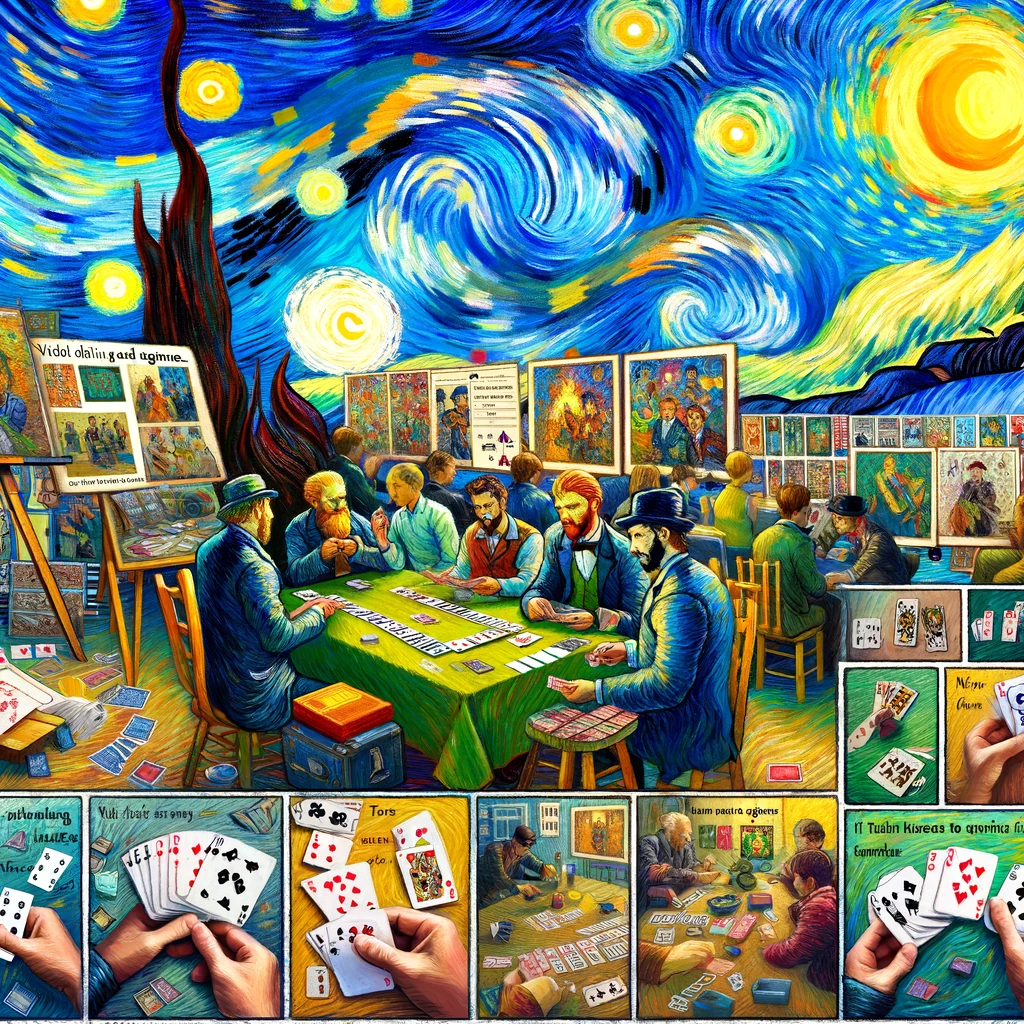
Cards in hand, we play,
AI weaves our tales anew,
Heartfelt bonds take flight.
Haiku
Poem
Can Artificial Intelligence Embrace The Art Of Storytelling In Card Game Journeys? – A Poem
A Card Game’s Heartbeat: Stories We Weave
In a circle of friends, ‘neath flickering light,
Laughter and whispers blend through the night.
With cards in our hands and stories to share,
Each shuffle a promise, a journey laid bare.
Technology blooms where the old tales still fade,
AI joins the table, the new bard, unafraid.
Not to erase the warmth of a human embrace,
But to weave richer narratives, let’s give it a space.
Picture a dragon, its breath fierce and bright,
Not just in combat, but in a saga of flight.
Each choice a brushstroke, each card a new thread,
In a tapestry living, where hearts and minds tread.
The rational voice asks, “Can machines understand?”
Can AI find meaning, or is it just planned?
It recognizes patterns, can mimic and create,
But the soul of our stories—who’ll narrate?
For ethics demand that we question and ponder,
The tales that we tell should unite, not to squander.
In concocting our fables, let us be wise,
Each voice must echo, not be left to demise.
With cards as connections, emotions entwined,
The game takes on layers, deep journeys defined.
Through victories shared and losses laid bare,
We find in each play the weight of our care.
As we grapple with trust, in machines that compose,
Will we lose the essence that our humanity knows?
Let AI guide us, not lead us astray,
In this intricate dance, let us find our way.
Together we travel, hearts open, minds free,
In storytelling’s realm, let’s shape what will be.
For every adventure, each tale lovingly spun,
In the game of our lives, let’s play, everyone.
So shuffle the deck, let the stories unfold,
With ancient and future, let histories hold.
In the heart of the game, and the bases we’ve laid,
We craft a new journey—together, unafraid.

Poem
Checklist
Can Artificial Intelligence Embrace The Art Of Storytelling In Card Game Journeys? – A Checklist
Checklist: Embracing AI in Card Game Storytelling
Heartfelt Connections
1. Nurture Relationships: Reflect on how storytelling enhances emotional bonds with friends and family during gameplay.
2. Celebrate Shared Experiences: Create moments that evoke laughter, tension, and joy, deepening your connections.
3. Craft Inclusive Narratives: Ensure the stories your card game promotes foster positivity and community rather than division.
4. Evoke Emotions: Aim for stories that resonate on a personal level, reminding players of their own struggles and victories.
Rational Engagement
5. Personalize Experience: Utilize AI’s ability to tailor narratives based on players’ choices and strategies, enriching the gameplay.
6. Encourage Critical Thinking: Include narratives that challenge players to think deeply about their decisions and their implications.
7. Meet Storytelling Standards: Define what makes a “good story” in AI-generated content, focusing on coherence, purpose, and emotional connection.
Ethical Considerations
8. Respect Shared Values: Promote storytelling that reflects diverse perspectives and experiences, ensuring all voices are honored.
9. Foster Responsibility: Create an ethical framework for AI participation in storytelling that avoids commodification of personal stories.
10. Hold Creators Accountable: Demand authenticity and respect in narratives generated by both humans and AI.
Authoritative Insights
11. Embrace Technology with Caution: Recognize that while AI can enhance storytelling, it should complement rather than replace the human touch.
12. Seek Expert Guidance: Engage with game developers and writers who understand narrative dynamics to craft meaningful stories that resonate.
13. Utilize AI as a Mentor: Allow AI to offer insights that can enhance player strategies and storytelling depth.
Narrative Explorations
14. Blend Human and AI Creativity: Explore pathways where AI learns from human storytellers, creating narratives that resonate with shared humanity.
15. Encourage Storytelling Games: Incorporate games that promote creativity, allowing players to co-author tales alongside AI.
16. Engage in Collective Storytelling: Create opportunities for players to share their stories and strategies, enriching the overall game experience.
Social Bonds
17. Build Community through Play: Leverage card games as platforms for connection, encouraging dialogue and shared narratives among players.
18. Emphasize Collaboration: Design gameplay that promotes teamwork and collaboration, reinforcing social ties.
19. Celebrate Individual Stories: Allow players to bring their personal narratives into the game, fostering a rich tapestry of diverse experiences.
Mid-Game Reflections
20. Reflect on Your Gameplay: After each session, consider how the stories played out and their emotional impact on you and others.
21. Adjust Strategies for Deeper Narratives: Be willing to adapt your approach based on the unfolding narrative and fellow players’ reactions.
22. Encourage Feedback: Solicit thoughts from players on the narrative’s effectiveness, both from emotional and rational perspectives.
This checklist aims to not only enhance your card game experience but also to embrace the merging of technology and storytelling in a way that enriches your social connections and brings out the best in both AI and humanity.

Checklist
At CardGameNews, we help people who love card games by collating information and news about card games.
Be sure to read our other related stories at CardGameNews to learn more about card games.